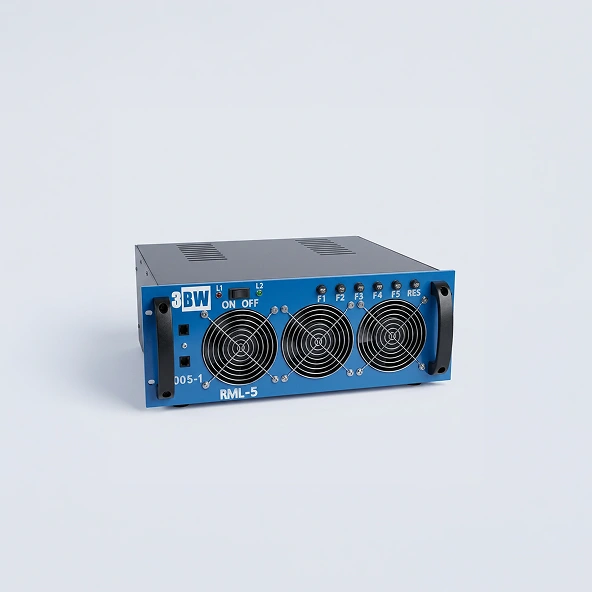
Rack Mounted Loads (RML) for Data Center Testing
The RML (Rack Mounted Load) of 8.75 kW is a resistive load equipment designed to precisely simulate the thermal dissipation and electrical consumption of IT equipment installed in racks, enabling the execution of controlled, safe, and repeatable tests in mission-critical environments. Installed directly in the standard 19″ rack, the RML enables validation of power and cooling infrastructure at the actual point of consumption, before servers and production equipment enter operation.
RMLs are primarily indicated for performing Integrated Systems Testing (IST), also known as Level 5 Commissioning, allowing integrated testing of UPS systems, PDUs, busbars, electrical panels, and cooling, with validation of the complete chain from the power source to the rack. The equipment is also widely used in Rack Acceptance Test (RAT), enabling acceptance testing directly at the rack level and simulation of real load before IT equipment installation.
Additionally, RMLs can be used in capacity and redundancy tests, covering N, N+1, and 2N architectures, enabling verification of system behavior under nominal load and simulation of failures, such as UPS transfers, power loss, and bypass operation. The equipment is also fundamental in thermal and airflow tests, allowing evaluation of hot and cold aisles, validation of cooling systems such as CRAC, CRAH, in-row solutions and containment, as well as identification of hot spots and air short-circuits.
Finally, RMLs are also indicated for the pre-operation or burn-in phase of infrastructure, promoting controlled stress of the environment before go-live and enabling anticipation of latent failures in power and cooling systems, contributing to safer and more reliable Data Center operation.
- Format: Rack Mounted (19") 2 UIs
- Load Type: Single-phase resistive load bank with 8.75 kW at 220V
- Stability: Stable resistive load, without real IT harmonics
- Thermal: Controlled thermal dissipation, simulating real server load
- Operation: Continuous operation for extended tests
- Voltage Range: Operates with voltages from 100Vac to 240Vac
- Channels: Five independent channels individually protected by fuse
- Power Supply: Independent power supply (200VA 100Vac~240Vac)
- Control: Chain connection with centralized control for up to 100 modules
- Dimensions & Weight: 88.9 x 483 x 302 mm (H x W x D) | 3.9 kg